How much of a festival lineup can you only see there
A lineup drop is news for a day. The more useful question is how much of that bill you cannot see anywhere else, and across 30 festivals the answer ranges from 72% to 8%.
A lineup drops, the poster goes around, and the argument starts inside an hour: stacked or mid. What nobody posts is the one number that separates a destination from a stop on a circuit — how much of that bill you can only see there.
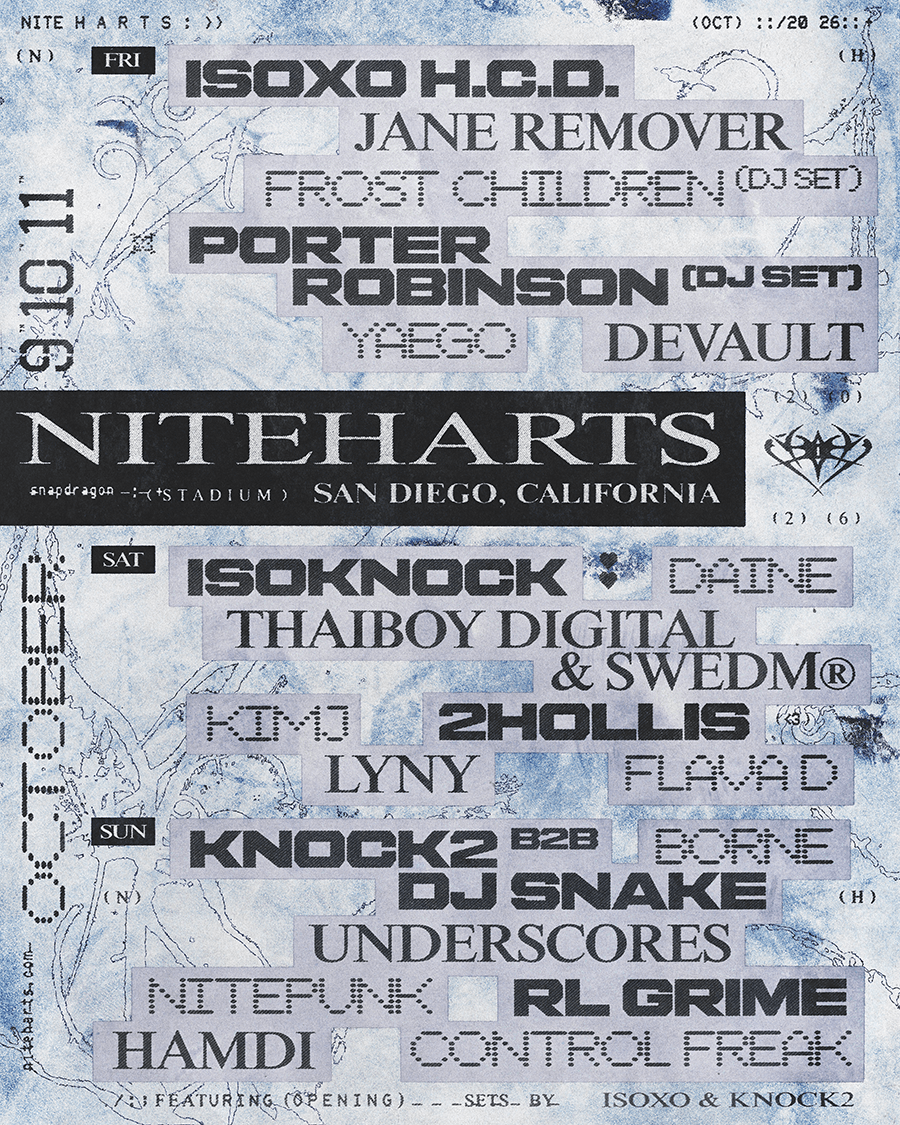
San Diego's NiteHarts announced its return this week, three days at Snapdragon Stadium on 9–11 October, and EDMTunes and the rest of the trades ran the names — here's the day-by-day poster. We can't add anything to the announcement. We can add the count.
Exclusivity is a measurable property of a bill
Call it exclusivity: the share of a festival's lineup that appears at no other festival in our index this season.
It falls straight out of the booking being the unit of record. Once every artist-at-a-festival-on-a-day is its own row, asking "how many of these names appear exactly once across the whole catalog" is arithmetic, not opinion.
NiteHarts comes out at 9 of 21 — 42.9%. Just over four in ten of those artists are, as far as our records go, not playing another festival this season. That includes the ISOKNOCK booking, which appears exactly once across all 67 upcoming festivals we track.
The spread is wider than anyone would guess
We ran it across every electronic-genre festival in the catalog carrying 30 or more announced names. Thirty festivals qualify. The median is 37.1%.
The ends are nowhere near each other.
The top of the range:
- Dreamstate SoCal — 71.8% (61 of 85)
- Same Same But Different — 64.6% (31 of 48)
- Nocturnal Valley — 63.5% (54 of 85)
- Creamfields — 60.0% (147 of 245)
The bottom:
- Bass Canyon — 18.6% (18 of 97)
- Lights All Night — 15.0% (6 of 40)
- Seismic Dance Event — 11.8% (4 of 34)
- Freaky Deaky — 7.7% (3 of 39)
Dreamstate books nearly three-quarters of its bill from artists who turn up nowhere else in the catalog. Freaky Deaky books thirty-six of its thirty-nine names from artists you can also catch somewhere else this season.
Nothing in that is a quality judgment, and it would be a misreading to take it as one. A trance festival scores high because trance runs its own booking pool, largely disjoint from the bass and house circuits — that's a fact about the genre's shape, not about anyone's curation. A festival that books from the shared touring circuit is doing the thing that fills a stadium. High exclusivity means hard to substitute. Low exclusivity means widely validated. Those are different products, and both of them sell.
What the number is genuinely good for is the question a promoter actually has to answer: if a fan can see two-thirds of this bill within a four-hour drive over the next eight weeks, what is the ticket for?
What this number cannot do
Our index is not the world, and the metric is only as honest as its caveats.
"Appears once" means once in our catalog of upcoming festivals. An artist playing club dates all autumn, or a festival we haven't indexed yet, reads as exclusive here and isn't. Exclusivity is a statement about festival bookings we hold, nothing more.
Three other things distort it, and all three are handled rather than ignored:
- Multi-genre bills score falsely high. Outside Lands measures 81.6%, well above any electronic festival — because most of its lineup is rock and pop that was never going to appear on a techno bill. It is excluded, along with every other lineup carrying non-electronic genre tags.
- Partial announcements are noise. Eight festivals in the catalog currently carry a single placeholder name. The 30-name floor keeps them out, and it's why NiteHarts's 21 names sit outside the ranked comparison and are reported on their own.
- Spelling variants inflate everything. The same artist arrives from different sources as
KETTAMAandKettama,ALLEYCVTandAlleycvt,2hollisand2Hollis. Sixty-four artists in the catalog have more than one spelling. Counted raw, each variant looks like a separate artist with a single booking — a machine for manufacturing fake exclusivity. Every figure above is computed on normalized names, which collapses 2,055 raw strings to 1,986 actual artists.
Aliases are the one we can't fully solve. ISOxo appears at NiteHarts as a hardcore-diva set, again inside ISOKNOCK, and separately at Ultra — three rows, one person, and the index treats a billed alias as its own act because that's how it appears on the poster.
The point
A poster tells you who is playing. It doesn't tell you where else they're playing, which is most of what a ticket decision actually turns on.
That gap is the whole reason we keep the count.
Tickets
Ticket links below are affiliate links.
- Bass Canyon — tickets via Front Gate
- NiteHarts — tickets via Front Gate
- Dreamstate SoCal — tickets via Front Gate
The Scene Index is a maintained dataset of festival bookings — who is booked where, on which day, alongside whom. If you want a number run against it, say what you're trying to answer: casey@electricstate.app.